Monday, December 20, 2010

Reprise of First Santa Cruz Local History Question/Article

Mission Street Safeway, Santa Cruz, CA.

    Here's the question I asked in Update #81 of the 1957 Santa Cruz High School Grads Mailing List on 26 May 2005.
....
    Santa Cruz History. What were the original names of Front Street and Pacific Avenue? (Extra-Credit Question: What was the previous name of Bay Street?) [Answers follow.]

    Answers to Santa Cruz History Questions (from Margaret Koch's Yesterday -- and the Day Before, c1964).

    "On July 7, 1846, Commodore John Sloat raised the American flag at Monterey. Santa Cruz County, originally named Branciforte County, was renamed in 1850 shortly after being designated one of the original counties by the first state legislature.
....
    "Pacific Avenue was Willow Street and Front Street was Main Street in the old days. When the center of business moved down from Holy Cross Plaza, it went to Main Street which even had (a few years later) real plank sidewalks. Then the big Bernheim Company store moved from Main to Willow and that was the end of Main as the main drag.
....
    "For 30 years the voice of the bull whacker and the sound of the axe were music for the Santa Cruz County's greatest industry: lumber. The fine virgin redwood trees fell, tree by tree, acre by acre, to make posts, poles, pickets, grapestakes, and boards for building homes. All this to the whining tune of the steel saws.
    "Loma Prieta, one of the county's largest mills, also had one of the greatest lumbering tragedies. The great earthquake of 1906 buried the cook shack, a bunk house and 13 men alive under tones of rock and dirt."
....
    A photo of Bay View Elementary, apparently taken in winter or early spring, in the Schools Section of the Santa Cruz Library's Local History web site, shows the large multi-story bldg at the corner of Mission Street and a muddy Lime Kiln Road.
--

    Am currently having the RV Service Center of Santa Cruz replace the weaker tie-downs for my camper with stronger Tork-Lift tie-downs as well as check the water pump for total functioning.
....
    While I'm currently staying at the McAlpine Lake & Park near San Juan Bautista each night, may try a couple of other RV Parks/Campgrounds in the area. And, if I can ever catch Watsonville's Pinto Lake RV Park open, will try it as well.

Saturday, December 18, 2010

Obituary for Margaret Hill Smith

San Juan Bautista Library

Margaret Hill SMITH
--
Obituary
--
Tuesday 10 April 1973 Palo Alto Times, p. 11
--
    Mrs. Margaret Hill Smith, who with her late husband, J. Gilbert Smith, formerly owned the property where the Los Altos Civic Center now stands, died Monday at Stanford University Hospital. She was 95.

    Mrs. Smith had lived for many years at 51 South San Antonio Road, at the rear of the Civic Center site in a house her husband, an orchardist, built. The house and one-acre lot where it was located now revert to the city, which may convert the old home into a museum.

    The Smiths sold the [9-]acre civic center site to the city in 1954.

    Mrs. Smith was born in Oregon and lived in Oakland before her marriage.

    Her parents donated the land on which the San Antonio Club is located on North San Antonio Road. Mrs. Smith belonged to the club. She also belonged to the Foothill Congregational Church.

    [Survivors include] sister-in-law Florence Hill of Los Altos; nieces Florence Paul of Oakland and Betty Ward of San Francisco and nephew McCoy Hill of Sacramento.

    Friends may call at the Los Altos Chapel of Spangler Mortuary, San Antonio and Lyell until 12 noon Wednesday. Friends are invited to attend services Wednesday, April 11, 1973, at the Foothill Congregational church, 461 Orange Ave., Los Altos, under the direction of Spangler's Mortuary.

    Inurnment private.
.......................................................................

And here's a link to the J. Gilbert Smith House, which has indeed become a museum. I was particularly impressed with the old 30s-vintage toaster which was exactly like the one owned by my maternal grandmother. (She'd be busy talking and burn the toast. "It's a little dark." And she'd scrape off some of the surface charcoal before covering it with margarine -- which may explain why til recently I much preferred butter!)

Sat 18 Dec Route:San Juan Bautista - Santa Cruz - McAlpine Lake & [RV] Park

Thursday, December 16, 2010

Palo Alto Veterans Hospital + J. Gilbert Smith's Obituary

Palo Alto VA Hospital

    Since some of you (especially my siblings and relatives) may be wondering why I'm at the PA VA Hospital, here's a brief summary. My appointment was with a pulmonologist named Dr. Mueen Ghani, whose parents are almost certainly natives of India. I've taken the 3 antibiotics prescribed for both TB and mycobacterium avium for 24+ months and there has been modest improvement in the CT Scans of my lungs a few month ago as compared with one 1.5 years earlier.

    But until I provide sputum samples [doc-speak for phlegm] on 3 consecutive days, it's impossible to declare the my MA has been conquered. Driving to either this hospital or to the Monterey Clinic on the former Ft Ord was an expensive proposition using my 87 Mazda, which got 34mpg for all but the last 2 months of the 10+ years I owned it. And my Ford F-250 only gets 12.5mph with its 3000-pound payload.

    But when Dr Ghani checked with his supervisor and told him I'd resume traveling early next year Dr Holty suggested that Dr Ghani perform a bronchoscopy under his supervision to obtain sputum samles for testing. Both explained the risks, but my only question was whether there had ever been a fatality while a PA VA Hosp doc was performing that procedure. There had not.

    When I countered that colonoscopies involved more than a few fatalities, Dr Ghani replied that the south end of one's GI track is not straight as is the top or north end; and colon contains much more bacteria than does one's throat.

    The procedure took less than the 30-60 minutes noted in the first poop sheet I received. While in the Recovery Room I wolfed down all of he chipped ice, jello, salt-less saltine & honey graham crackers provided. So they told me to get dressed and move to another room with a large bathroom containing a shower.

    Ate the lunch, which wasn't bad -- especially the turkey loaf. Afterward I used the bathroom to drain my my radiator. Began coughing & coughed up some blood -- but that was on their after-procedure poop sheet & not a cause for worry unless it was more than 2 tablespoons. However, my right lung, which formerly had a cavity which has now disappeared, hurt. And I was short of breath. The nurse who came to pick up my nearly empty lunch tray put me back on the lung and pulse monitor and told her supervisor of my problems.

    After the Recovery Room Supervisor talked with me and with the the pulmonary department we compromised on my going to the ER; instead I walked to the pharmacy to picks up some meds but agreed that I'd go to the ER if my rt lung began to hurt more.

    It did not and I'm back in my camper, where I have slept better than inside our former home at 135 Van Ness in Santa Cruz. Yes, even before I had sore lung, one of the nurses said the Pulmonary Unit wanted me to check in with them before I drive off of the hospital grounds. While I have "cut out" from commercial hospitals such as Fresno Community and Dominican Hospitals, I had no intention of driving back to SC tonight since it takes 24 hours for the effects of medications which might impair my judgment to wear off.
--
    Also, I want to return to the Palo Alto Library to look up an obit for the wife of J. Gilbert Smith, younger brother of former SCHS math teacher (geometry & trig), Harlan C. Smith, who likely told Alpheus of a 3-room rental during WWII offered by former RE agent Fred Garrison. [As I've said previously, my late father bought that house from Fred's widow, Hattie Garrison, in Nov 1954.]

    Here's Julian Gilbert Smith's obituary.
....
Julian Gilbert SMITH
--
Obituary
--
Wednesday 25 May 1966 Palo Alto Times, p. 7
--
Sold Land to City
--
Orchardist J.G. Smith Dies
--
    Funeral Services will be held Thursday for J. Gilbert Smith, the long-time Los Altos orchardist who sold the city its present Civic Center site.
    Mr. Smith, 89, died Monday in a Mountain View rest home after several years of failing health.
    He had lived for 65 years in the house he built at 41 San Antonio Road, adjoining the Civic Center. He had worked his trees up to about four years ago when his health began to fail.
    In 1954 he and his wife, Margaret, sold nine of their 15 acres to the city for $115,000 for the present Civic Center, which includes City Hall, the police station, youth center, and library.
    The city since has acquired all the property except for a 1 3/4 acre homesite.
    Mr. Smith moved to California from his native Oregon at the age of 18. After a year's study at Stanford University he became a carpenter, working mainly in Palo Alto and Los Altos.
    His wife said he was always pround that none of the houses he built was damaged by the great 1906 earthquake which toppled many other buildings. Most of his houses are still standing in downtown Palo Alto, she said.
    Mr. Smith bought five acres on San Antonio in 1904, planted apricot trees and built his house. Through the years the couple acquired additional land.
    He had been a member of the Foothills Congregational Church in Los Altos.
    He also leaves a brother, Harlan C. Smith, a [former] Santa Cruz High School teacher[, and was predeceased by a sister, Elinor Smith, who taught nature study at Carmel High School.]
    Funeral services will be held at 11 a.m. Thursday at the Los Altos chapel of Spangler Mortuary, San Antonio Road at Lyell Street.
    Private interment will be at Alta Mesa Cemetery, Palo Alto.
.......................................................................

    Here a link to Harlan's obit on the World Connect Van Ness Neighbors site, which is all-text.

Fri 17 Dec 10: PA VA Hosp - Palo Alto Library - Santa Cruz - McAlpine Lake & Park.

Tuesday, December 14, 2010

Mission San Juan Bautista

McAlpine Lake & [RV] Park

 
    While I drove by San Juan Bautista on SR152 prior to the 17 October 1989 Loma Prieta Quake when I made fishing trips in the Sierras east of the San Joaquin Valley cities of Madera south through Visalia, I changed my route even for fishing trips to Tuolumne County, for which I formerly had been motoring through the SF Bay Area.
....
    But now that I've retired and no longer am caring for one or both of my parents, I have time to stop and investigate some of the things I have whizzed by during my many Sierra fishing trips. Here are four photos taken Monday 13 Dec.

    The first thing which impresses one at Mission SJB is its size; it's the only mission of the 21 California missions which has 3 aisles. (Presumably, all of the others have 1 or 2 aisles.) And it's still in use -- though the San Carlos Catholic Church in Monterey bills itself as the oldest, continuously-used church of that denomination in the United States.
....
    There are likely older churches in Saint Augustine, Florida, dating from the 1500s whereas most, but likely not all, of the California missions were built during the last half of the 1700s -- if memory serves.


This second shot includes a sign containing the following information: "MISSION SAN JUAN BAUTISTA. Founded June 23?, 1797 by Father Lasuen. 15th of the 21 missions. Largest and only church with 3 aisles. Dedicated in 1812. Monastery wing consisted of 36 rooms. This mission has never been abandoned. It is now the parrish church of San Juan Bautista."


Here's the text from the third photo.
....
    El Camino Royale: California's Royal Road. In 1769 Spain began occupying what is now California. Franciscan padres supervised the construction of 21 missions to convert the Californian Indians to Roman Catholicism and teach them European agriculture and trade. The military established four presedios (forts) to protect the new colonies.
    Travel between the new settlements was difficult due to the great distances and rough terrain. Establishing a connecting road system was vital to the Spanish success. The native Californians had established routes to their hunting, gathering, and trade areas. The road and routes varied with the seasons. The Spanish followed and expanded these existing routes to link the missions, presedios, and peublos (towns). Some of these routes became the Royal Road, today's El Camino Real.

....
    Today, US-101 and California SR1 follow much of the El Camino Real.


    The fourth and final snapshot is of Plaza Hall (not to be confused with the Plaza Hotel, which is across Third Street from the mission), and a large barn or stables.

    Some Links:

Tuesday's Route: San Juan Bautista - Watsonville - Santa Cruz Wed 15 Dec 10 Route: Santa Cruz - Palo Alto VA Hospital Thur 16 Dec 10 Route: PA VA Hosp. Fri 17 Dec 10 Route: PA VA Hosp - Santa Cruz - McAlpine Lake & Park

Sunday, December 12, 2010

Photo Gallery2

Hollister Inn, CA.

While attending San Jose State I worked during the summers for the US Forest Service in the Stanislaus Natl Forest; the first two summers, '58 & '59, were in the Groveland District.
....
This first photo [click on it 1 or 2 times for a bigger photo] was taken from a hilltop to the left of SR120 a few miles past the Groveland Ranger Station and was an attempt to capture a view to the NE including the snow on the higher Sierra peaks.


The second shot was taken from a slightly different spot on the same hilltop -- but looking to the SE.


One of the shortcuts to following SR120 to the Groveland RS which locals told me about was the Ferretti Ranch - Big Creek Rd (now Ferretti Rd). The first shot was taken about 1.5 - 2 miles past the junction with the Lumdsen Bridge Rd looking NNE.


Moved further back up Ferretti Rd to take another shot through the break in the tall roadside brush and trees.


Don't know if this is true or not, but Priest's Grade from just below Big Oak Flat down to Mocasin was reputed to have 166 turns in its six miles -- but there are plenty of turns.
....
This view is of the northeastern arm of Don Pedro Reservoir and Mocasin Creek.


Houseboats on Don Pedro taken from near a boat ramp below the Mocasin Point RV Campground.


RIP Jacksonville, CA! When the New Don Pedro Dam was built the enlarged reservoir buried Jacksonville under c70 feet of water, a fate suffered by several other Mother Load gold-mining towns.


Sunday's Route: Mocasin Pt RV CG - Chinese Camp - Red Hills - Waterford - Turlock - Los Banos - Hollister
--
Monday's Route: Hollister - Watsonville - Santa Cruz

Saturday, December 11, 2010

Ruth & Clifford Colberg Photo + Historical Marker #423

Groveland Branch Library, CA.


Finally learned how to upload individual photos to Picasa, Google's photo program and one of the easiest way to post photos to a blog on Google's Blogspot. (When Picasa scans your computer for photos it may miss some folders [or directories for the few remaining DOS-jocks out there].)

This photo was scanned to photo paper by Doug Colberg when I visited him at his Weaverville home. Then John Mottoros scanned it to a digital image while I was staying with him and Nadine at their Sutter Creek estate.

Not sure exactly when this photo of Clifford and Ruth Anderson Colberg was taken, but perhaps their son Doug can provide an approximate date. [Clifford passed on in 1986.]


Chinese Camp Hisorical Marker. Among other things, State Historical Marker #423 indicates that Chinese Camp was established c1849. The most notable inclusion is that the first Chinese Tong War in the state was fought near Chinese Camp.
....
Here are three links with more info or photos:

Route for Sa 11 Dec: Sonora - Chinese Camp - Groveland - Groveland District Ranger Station - Mocasin Pt RV Campground (on Don Pedro Reservoir)

Friday, December 10, 2010

Tuolumne Fireman's Theatre and the Carter Cemetery

Southern Rim of the North Fork of the Tuolumne River Canyon

    As you can see from this first photo there's not much left of Tuolumne's Fireman's Theatre. This concrete block and brick building was constructed in 1945-1946 after the previous wooden Theatre burned down. Unlike the previous buildings, which were flat and had folding chairs which could be moved to create a dance floor, this moviehouse had a floor which sloped upward from the base of the stage at the back of the building where the screen was located to the projection booth, whose windows one could see high at the front of the building.

    If memory serves, films were shown on Wednesday, Saturday, and Sunday. My late grandfather, David Wilcoxson, was one of the projectionists along with the late Adolph Antinetti [see obituary below], who was one of those who obtained the plans for this somewhat more flame-retardant building.

Despite the composition of the exterior of this Fireman's Theatre [hereinfafter TFT], the interior was still mostly wood, which led to its eventual demise via fire sometime in the early 1960s. [If you have some knowledge of the TFT because you attended movie shows there and/or are a descendant of one of the fireman who either worked on the construction of the building or who operated this film-house, please send me an e-mail.]

    While I learned of a few lifelong Tuolumne natives who have some knowledge of the history of the TFT, I've just now begun to work on assembling a brief history of Tuolumne's long-running hometown cinema.

Tuolumne's Carter Cemetery [Established 1854]


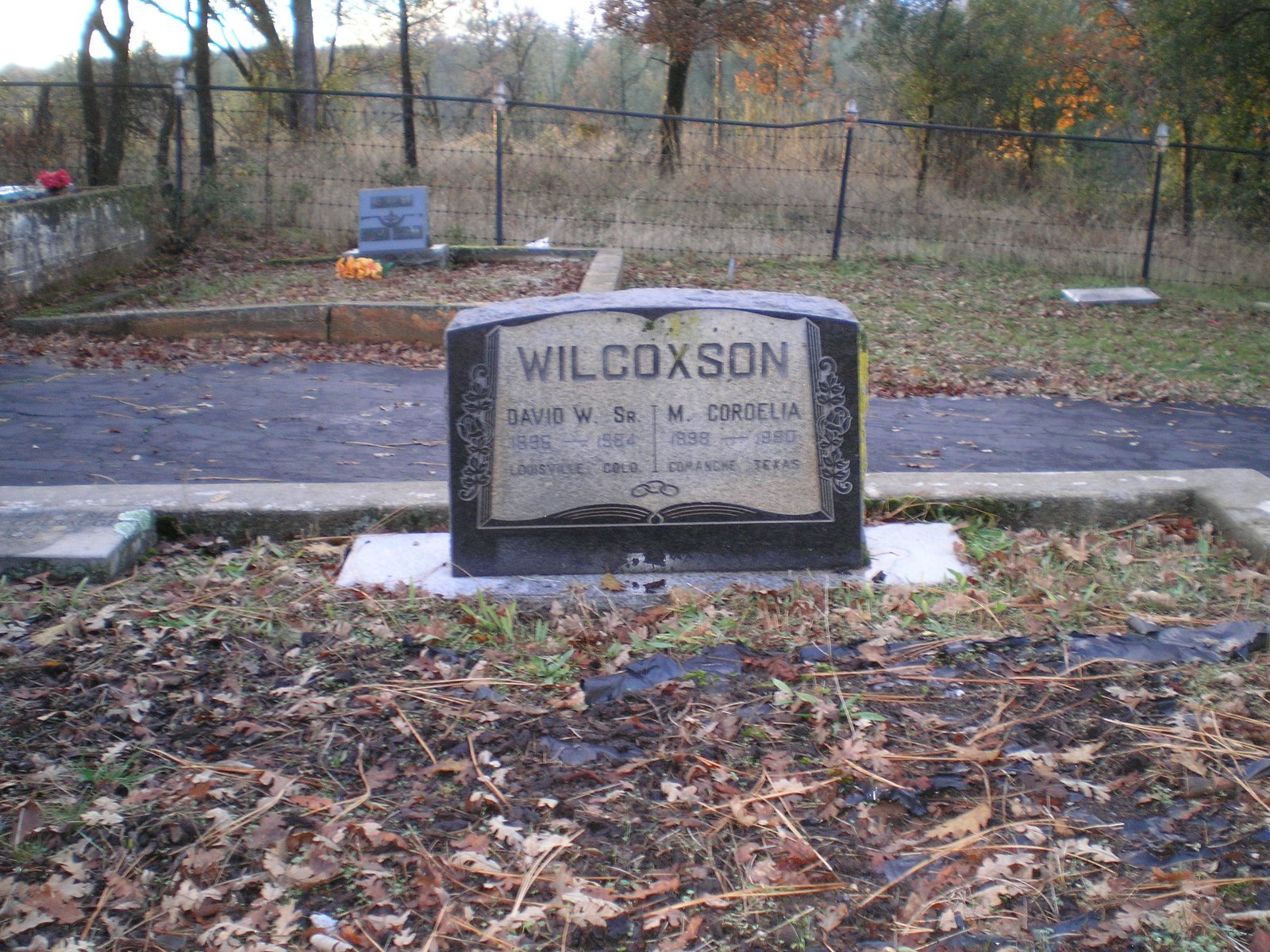
    Here's the headstone for my grandparents, David W. Wilcoxson and Mary Cordelia Shackelford Wilcoxson. (Obviously I'll be back this summer to remove the black plastic along with any plants and weeds which sprout next spring.)


    The second Carter Cemetery photo shows the two additional gravestones in the Wilcoxson family plot. On the left is David W. Wilcoxson, Jr's and on the right is that of Cordelia's mother, Martha Elizabeth "Lizzie" Farley Schackelford Colbaugh [that's a mouthful!].


    As I was leaving yesterday I noticed a barber pole within one plot. That could have been for only one person: Johnny the Barber; but I decided to return this morning to take a photo of his plot. But this morning the gate to the cemetery was closed with a "Fresh Oil" sign on it. (Had noticed some new new asphault, but didn't realize how new it was.) In any case, I had to back down the hill using my side-view mirrors -- something I try to avoid.
--
    Johan "Johnny" Whittorf cut my hair many times when we five Lemmon kids spent most of the summers between 1948 and c1954 with our grandparents. Johnny had no relatives, and when he died he left a bigger estate than one might expect. Over the years he was a barber he invested in stocks. And by the time of his death in 1958 those stocks had risen in value. If memory serves, he willed the bulk of his estate to Summerville Elementary School -- though it's possible that Summerville High School also benefited from his version of The American Dream.

Obituary - Adolph Antinetti, Feb. 10, 1906 - Jan. 1, 2004
Longtime Tuolumne resident Adolph Antinetti died Thursday at a Sonora hospital. He was 97.

He was born in Angels Camp and came to Tuolumne City when he was 2 years old. His parents were Charles and Jenni Antinetti.

He served as the timber foreman of the Lightener Gold Mine in downtown Angels Camp. After traveling to Tuolumne City by the Sierra Railroad's Angels branch, they purchased and operated the Alpino boarding house, which was home to many West Side Lumber Company mill workers. Later, his parents moved to Sonora and ran the well-known Europa restaurant on Washington Street.

He attended Summerville Elementary School and Summerville High School. As a youth, he ran three trap lines south and east of town in the North Fork of the Tuolumne River Canyon. He and a close friend, "Chivy" Van Opstal, skinned their catch before going to class at the grammar school. At age 14, he worked summers in the West Side box factory and, at age 16, went to work in the woods at Hull Creek running a steam saw. At age 17, he owned and operated the Pastime Pool Hall on the corner of Chestnut and Main streets in Tuolumne. He sold candy, tobacco and sporting goods and ran card games. It was a popular establishment in those days, his family said.

On Aug. 11, 1928, he married Erna Rosasco, the daughter of Henry and Aurelia (Sivori) Rosasco, in Reno, Nev. They had two sons, Norman and Allan, who became high school teachers and coaches.

His family said he was a hard worker and pursued many interests. He worked with Fred Leighton building check dams in the Emigrant Basin. He ran a herd of cattle with Henry Rosasco. He worked for the Tuolumne County Road Department. He was a blacksmith and shoveled mine rock in the Soulsby Belle Gold Mine. During the Great Depression in 1933, he left home for seven months to take a seven-day-a-week road construction job in Sequoia National Park.

He was a Tuolumne City volunteer firefighter and was serving on the Tuolumne Fire Department Board of Directors when the first fire engine was purchased. He and a good friend, Bill Archer, acquired the plans for the Tuolumne Fireman's Theater, where he often operated the projectors.

In later years, he ran the gas shovel for West Side Lumber Company, building railroad grades at camps 43 and 44, around Woods Mountain and across Cherry Valley to Wilson Meadow. Many of these railroad grades are the present-day Forest Service roads in the area of Cherry Lake. In the 1940s, he left the woods and became part owner of the Shell gas station on Carter Street in Tuolumne. His partner was Bruce Nelson, and they ran a successful business for 24 years, his family said.

He retired in 1969 and remained active. He was a founding member of the Tuolumne Rod and Gun Club, a 41-year member of the Sonora Elks Lodge, a parishioner of St. Joseph's Catholic Church and belonged to Figli d' Italia. He loved riding his trail bike around Tuolumne and in the mountains, where he continued to fish and hunt, his family said. He rode trail bikes until he was 87 and drove his cars until he was 96.

In the early 1990s, he was co-grand marshal of the Tuolumne Jubilee Parade with his good friend, Al Bonales, with whom he cut firewood until they were well into their 90s.

He is survived by two sons and daughters-in-law, Allan and Mary Antinetti of Tuolumne and Norman and Pam Antinetti of Oakdale; grandchildren and spouses, Mark and Joanie Antinetti and Linda Antinetti Cazares, and her husband, Roberto, all of Tuolumne, Amy Antinetti of Turlock and David and Rachelle Antinetti of Oakdale; and five great-grandchildren.

A rosary is scheduled for 6 tonight at Heuton Memorial Chapel. A funeral service is scheduled for 10 a.m. tomorrow at St. Joseph's Catholic Church in Tuolumne.

Heuton Memorial Chapel is handling arrangements.
[From the 5 Jan 2004 Sonora Union Democrat]

--
F 10 Dec Route: Sonora - Groveland